The Number That Explains Why Your Business Is Profitable But You're Always Broke
There's a number most CPG founders have never heard of. And it might be the single best explanation for why your P&L says you're doing fine, but your bank account tells a completely different story.
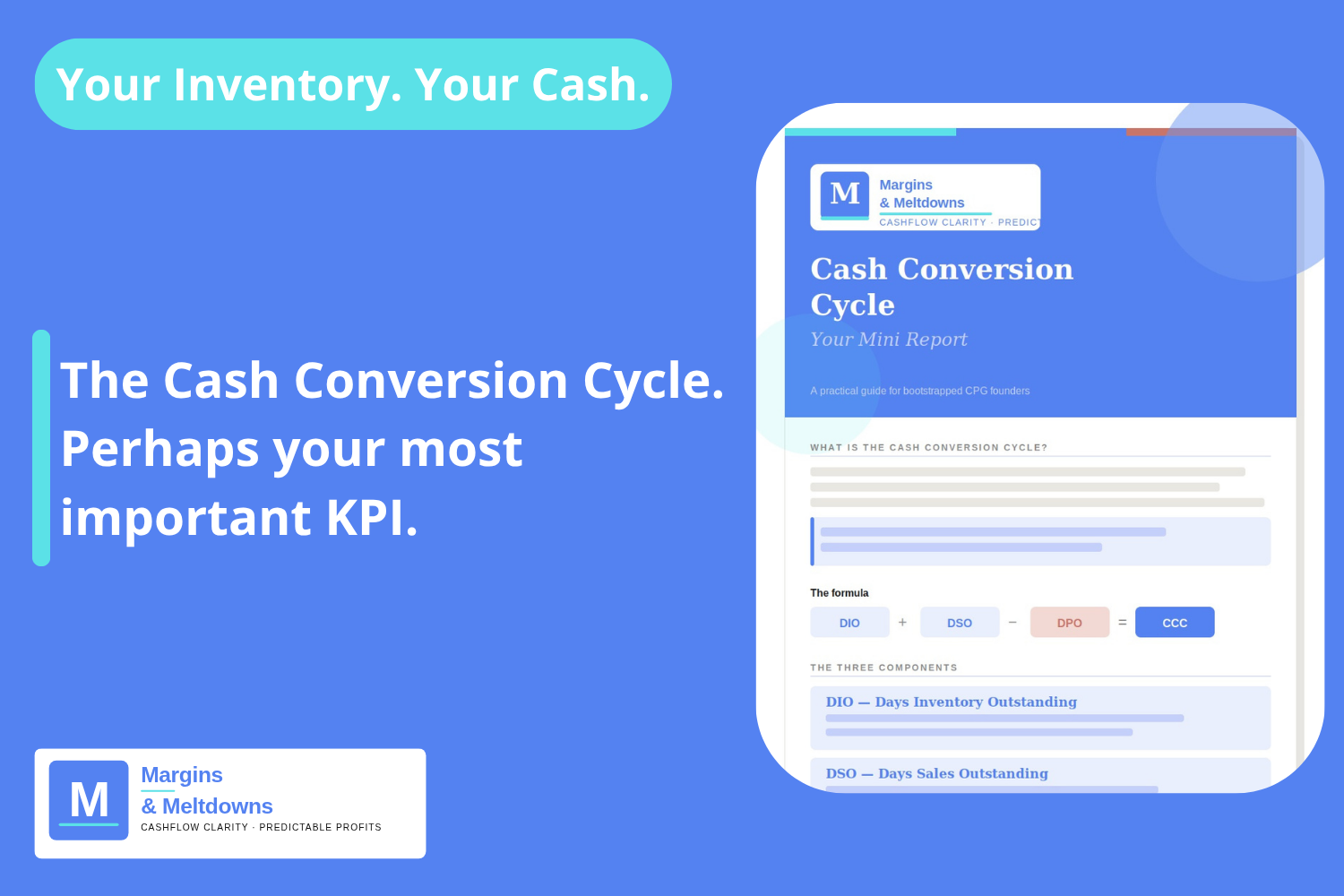
It's called the cash conversion cycle — CCC for short — and it measures one simple thing: how many days pass between spending cash on your inventory and getting that cash back from a sale.
That's it. But the implications are enormous.
How it works
The CCC is made up of three components.
Days Inventory Outstanding (DIO) — how long your inventory sits before it sells. Every day product is on a shelf or in a warehouse, your cash is frozen inside it.
Days Sales Outstanding (DSO) — how long it takes to collect payment after a sale. For DTC and Amazon brands this is usually short. For wholesale, it can stretch to 60 or 90 days depending on your payment terms.
Days Payable Outstanding (DPO) — how long you take to pay your suppliers. This is the one you want to be as high as possible. The longer you hold onto cash before paying out, the more working capital you have available.
The formula: CCC = DIO + DSO − DPO
A positive number — say, 75 days — means you're out of pocket for 75 days between spending and receiving. The higher that number, the more working capital you need to keep the business running. A negative CCC means you collect from customers before you have to pay suppliers. That's the holy grail, and it's how Amazon, Costco, and most major retailers actually operate.
Most bootstrapped CPG founders? Nowhere near negative. Most are sitting somewhere between 60 and 120 days — funding a significant float out of their own pocket, every single cycle.
Why this hits product businesses so hard
If you're selling services, your CCC is often close to zero — you do the work, you invoice, you get paid. There's no physical thing sitting in a warehouse slowly turning your cash into dust.
But if you're making a physical product, the cycle starts the moment you place a purchase order. You pay for raw materials or finished goods. You wait for manufacturing. You wait for shipping. You clear customs. You store it. You sell it. Then — if you're in wholesale — you wait another 30 to 90 days to actually collect.
For a brand importing from overseas, it's entirely normal for the CCC to stretch past 90 days. That means at any given moment, three months' worth of inventory spend is just floating. Tied up. Unavailable.
And because most accounting software shows you profit before it shows you cash, founders get a deeply misleading picture of their financial health. You can be genuinely profitable and genuinely broke at the same time. The CCC is the explanation for how that's possible.
The three levers you can pull
Once you know your CCC, you can actually do something about it.
Reduce DIO — usually the biggest lever. Tighter inventory management, better demand forecasting, faster-moving SKUs, and smaller but more frequent orders can all compress the time your cash is locked up in stock. Every day you shave off DIO is a day of working capital freed up.
Reduce DSO — if you sell wholesale, payment terms become a negotiation, not a formality. Net 30 vs net 60 is a 30-day difference in when cash arrives. Deposits, early payment discounts, and stricter follow-up on outstanding invoices all help.
Increase DPO — often the fastest win available. Can you negotiate 30-day terms with your supplier instead of paying upfront? 45 days? The longer you can hold cash before it leaves your account, the healthier your cycle.
Why Profit First helps — and why it's not enough alone
Profit First is built on the reality that cash flow and profit are not the same thing. The system works by giving every dollar that arrives a job immediately — before it gets spent on something unplanned.
But here's what founders often miss: Profit First allocates cash as it arrives. If your CCC is 90 days, there are 90 days where cash simply hasn't arrived yet. No allocation system can fix a gap that wide on its own.
The CCC is the upstream diagnosis — it tells you why the gaps exist. Profit First is the real-time discipline — it tells every dollar what to do the moment it arrives. Cash flow forecasting is the downstream map — it shows you where the gaps will land on the calendar. You need all three.
Calculate yours
You don't need an accountant to get a rough CCC number. You need your annual COGS and average inventory value (for DIO), your annual revenue and average accounts receivable (for DSO), and your annual purchases and average accounts payable (for DPO).
Run those through the formula and see where you land. Under 30 days is healthy. 30–60 is manageable. Over 90 is a warning sign that your working capital needs are significant — and they need to be planned for explicitly.
I built an interactive CCC calculator — you can find it in the Calculators section.
Your cash conversion cycle isn't just a metric. It's a story about how your business actually works. And once you can read that story, you can start rewriting it.


Member discussion