Dear Bootstrapped Founder: That Tax Bill Means You Won
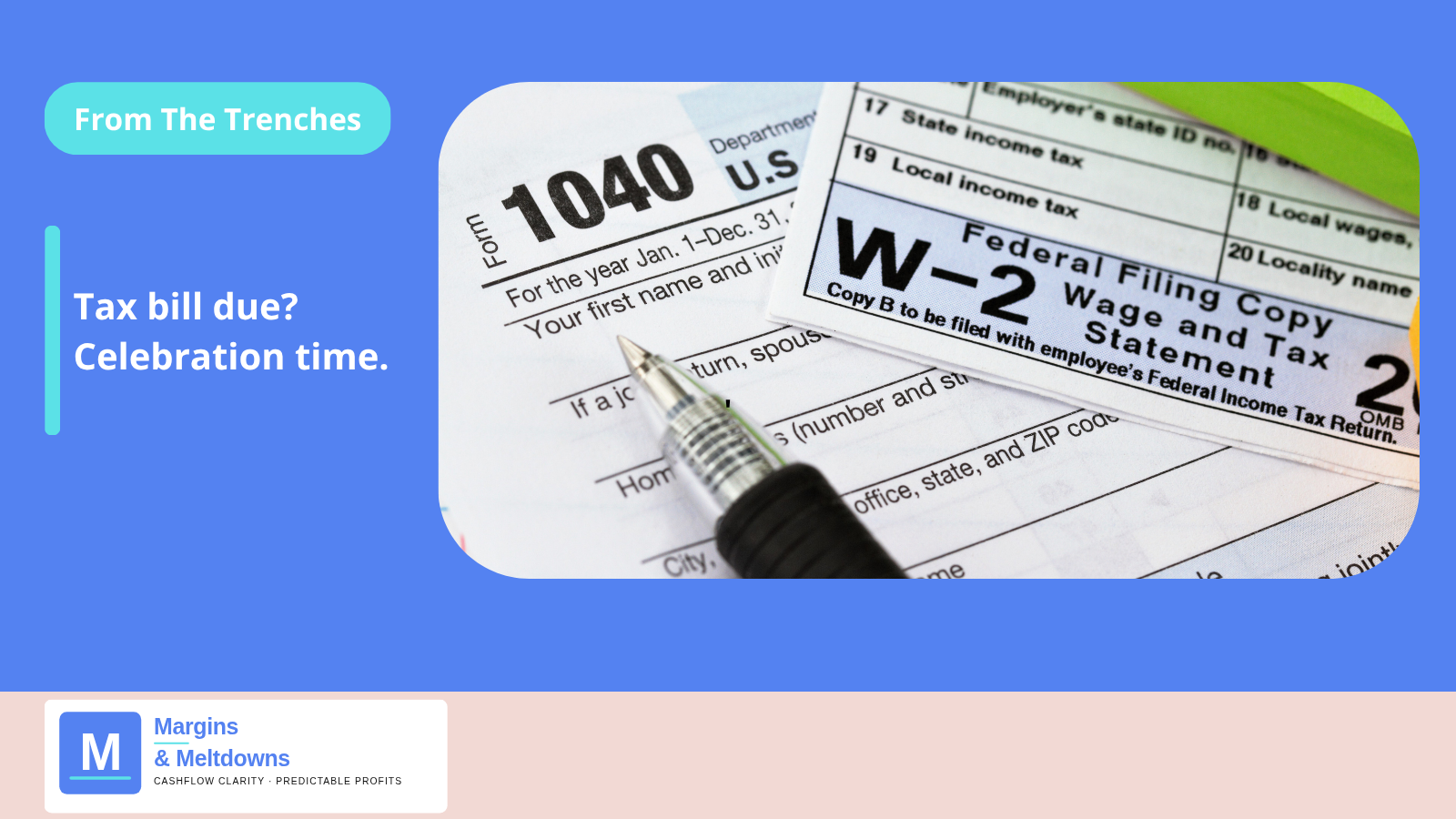
I'm writing this on April 7th — tax payment day for small businesses in New Zealand. And if you're reading this in the US, your deadline is one week away.
So if your stomach just tightened a little? You're exactly who this is for.
Tax season. Just reading those two words probably triggered something in your body. A low-grade dread. A vague anxiety you can't quite place. A mental list of things you should have done differently last year.
I know that feeling well. Because I lived it for years.
I ran my skincare company for a long time before I found Profit First. And every spring, my accountant would deliver what he seemed to think was great news.
"Congrats, Jen — you don't owe any taxes this year!"
He'd say it with genuine warmth, like he'd done me a favor. And I'd smile and nod and feel... relieved? I think?
But I also always thought: maybe my accountant should be asking me whether I was spending too much. Whether we should look under the hood at my profitability drivers.
The backwards way we've been taught to think about taxes
Here's the thing nobody tells you when you start a business: not owing taxes isn't automatically a win.
Not owing taxes means you didn't make much money. Or that you spent so much trying to reduce your tax liability that you hollowed out the very profitability you were working so hard to build.
Either way, the government's congratulations aren't coming. But neither is your financial freedom.
We've been conditioned to treat the tax bill as the enemy. To spend December scrambling for deductions, buying equipment we don't really need, prepaying expenses, doing anything to shrink that number. And yes, smart tax strategy absolutely has its place.
But when tax avoidance comes at the expense of your owner's pay? When it comes at the expense of your profit? When you're making yourself look broke on paper to avoid a bill?
That's not strategy. That's self-sabotage with extra steps.
A tax bill is your scoreboard — it means you won this year
I want you to really sit with this for a moment.
Paying taxes means you made money. It means your business is profitable. It means you paid yourself. It means you did it.
As a bootstrapped, inventory-based business owner, profitability is not a given. It is earned. It is fought for. Every purchase order, every production run, every net-30 invoice you're floating while your shelves are full and your bank account is anxious.
When you send that tax payment to the government, the correct response isn't dread. It's pride. Tempered, strategic, well-planned pride — but pride nonetheless. A tax bill is evidence that you pulled it off.
The goal was never zero taxes. The goal was a thriving business that generates real wealth for you and your family. Taxes are a byproduct of that success. Start treating them like one.
Why Profit First makes tax season almost boring
This is where everything changes.
If you're not familiar with Profit First — Mike Michalowicz's methodology that I use in my skincare company — the core idea is simple: you allocate your revenue into separate accounts — profit, owner's pay, taxes, inventory, and operating expenses — every time money comes in. Before you pay bills. Before you invest. Before you do anything else.
You decide the percentages in advance. You move the money. And then you only operate on what's left in OpEx.
The tax account is non-negotiable. Every single time revenue hits, a percentage goes directly to taxes. Not when it's convenient. Not if there's enough left over. Every single time.
What this means at tax time is almost anticlimactic: the money is already there.
No scrambling. No borrowing from savings. No putting it on a card and hoping Q2 covers it. No "I had a great year but somehow I'm broke" spiral that is tragically common among product founders.
You open the tax account. The money is sitting there. You pay. You move on.
That's it. That's the whole magic trick.
Smart tax strategy still matters
I want to be clear: I'm not anti-tax strategy. I love a good deduction. I believe in working with a sharp accountant who understands product businesses and knows how to minimise your liability legally and intelligently.
But there's an order of operations here. First, you build a profitable business, while paying yourself a real owner's salary, and while allocating to taxes so you're never caught short. Then — from a position of actual financial health — you work with your accountant to reduce what you owe through legitimate strategy.
Tax reduction is a tool. It is not a substitute for profitability. It is not a reason to underpay yourself. And it is absolutely not worth engineering your business to look like it's failing just to avoid the honour of owing money.
A different kind of accountant conversation
Imagine sitting down with your accountant and having a completely different experience than you've had before. Not dread. Not damage control. Not creative scrambling.
"Here's what I made. Here's what I saved. Here's what I owe. Here it is."
That conversation is available to you. It starts with the decision — made today, not next March — to treat your tax account as sacred. Not as a rainy-day fund, not as an inventory bridge, not as a number you'll deal with later.
Start your Profit First tax allocation this week — even if it's a small percentage, even if the account only has $50 in it. The habit matters more than the amount right now.
Profit First doesn't make taxes fun. Nothing makes taxes fun. But it makes them manageable, expected, and honestly — when you zoom out — something you can genuinely feel good about.
You built a business profitable enough to owe money to the government. Congrats. That's actually the point.




Member discussion