Three Things a Mountain Reminded Me (That I Already Knew)
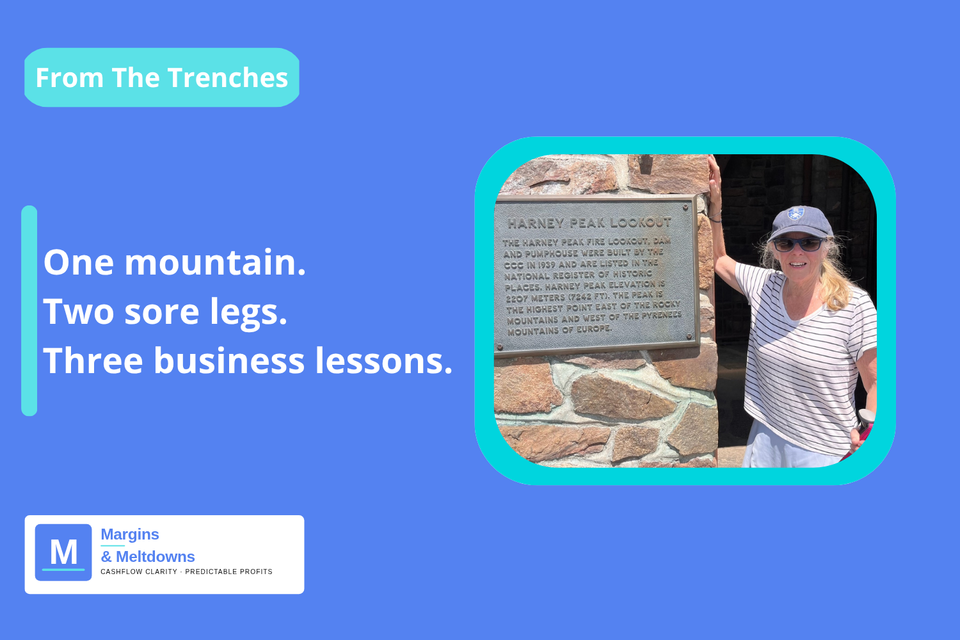
I spent last week camping in the Badlands and the Black Hills of South Dakota with my husband Mark. We hiked up to the Harney Peak fire lookout tower — the highest point east of the Rockies and west of the Pyrenees, which sounds like something someone made up until you’re standing on it, slightly out of breath, looking at everything.
I’d been looking forward to the quiet of it. No email. No Shopify dashboard. No spreadsheets.
What I got instead were three reminders. Not revelations — I want to be clear about that. I knew all of these things already. But there’s something about putting yourself on a mountain that strips away the noise and lets the stuff you already know become very loud again.
1. You never know anyone’s story.
There was a mother and daughter on the trail with us for most of the climb. They had a speaker. A loud one. Playing music the entire way up.
I’ll be honest: I was annoyed. Mark and I kept leapfrogging them on the switchbacks — they’d stop to rest, we’d overtake; we’d pause, they’d pass us, music trailing behind. We had a whole conversation about it, the kind of low-grade grumble that becomes its own entertainment on a long hike. By the third switchback I’d assembled a fairly complete character sketch of both of them. I was quite pleased with it.
Up at the summit, we got talking.
This mother had had three strokes this year. Heart surgery to repair a hole in her heart. A double knee replacement. She had spent more of this year in hospital than out of it. The hike — this specific hike — was her proof of something. Her way of standing at the top of something hard and saying: look how far I’ve come. The daughter had been quietly terrified the entire way up. The music was keeping her mother’s spirits high and her own nerves from unravelling.
I stood there feeling about two inches tall. And then I felt grateful.
Because here’s the thing: you don’t know what’s happening behind anyone’s door.
The competitor who looks like they’re absolutely thriving might be operating on personal loans and caffeine. The supplier who’s gone quiet isn’t necessarily being difficult — they might be dealing with something you can’t see. The customer who left the passive-aggressive review might be in the worst year of their life.
This doesn’t mean you excuse bad behaviour or smile through legitimate problems. It means you stay curious before you go cold. It means you don’t close a door in judgement when you could open it with a question. In eighteen years of running a product business, I have been wrong about people’s motivations more times than I’ve been right. Usually, there was a reason I hadn’t thought to ask about.
2. There’s no outcome at 99 degrees.
Just as we turned back from the summit, the sky cracked. A proper clap of thunder — the kind that comes from directly above you, not from a respectable distance. The Needles were already grey. We had to get off exposed granite, fast.
I was tired. We’d climbed over 300 metres. My legs had made their feelings known. But there was no meaningful version of events in which I got to be tired and slow. So I stopped thinking about tired and started thinking about the path in front of me.
And here’s the thought that landed: there is no desired outcome at 99 degrees.
Water at 99 degrees is warm. It’s producing heat. It’s using all the energy you’re feeding it. But it is not doing what you need it to do. It won’t boil. It won’t cook anything. It won’t do the one thing you actually need it to do. You need 100 degrees. Full boil. That is the only temperature that matters.
I think about the founders I work with — and honestly, about myself at various points — who have been sitting at 99 degrees for months.
You’ve done the research. Read the books. Built the spreadsheet. You’ve thought about the thing from every angle and had seventeen internal conversations about whether now is the right time. You haven’t launched it, sent the email, made the call, or committed to the decision. You are generating enormous amounts of heat.
But 99 degrees produces no transformation.
What often pushes people to 100 is external pressure — a tax bill, a supplier relationship that collapses, a moment where staying still becomes more frightening than moving. But you don’t have to wait for the thunder. You can choose to turn up the heat yourself. The capacity for 100 degrees is already there. The question is whether you’re willing to reach it before something forces you to.
3. The downhill is not always the easy part.
Here’s something you might not know about me: I am a mountain goat on the uphill. I love the burn of it. Mark and several of my hiking friends — Zaida, I see you — are far more measured on the way up. Steady pace, regular breaks, very sensible. I’m the one charging ahead, slightly insufferable about it.
On the way down, the tables turn completely.
I’m 5’1”. I have broken my wrists multiple times in my life and my body has not forgotten any of it. My balance does something peculiar on descents that I’ve never fully resolved. On a wet granite staircase, in the middle of a storm-accelerated exit, I was suddenly the one who needed my poles, needed to hold the rail, needed considerably more time than Mark.
He waited. He always waits. He’s good at that.
But it got me thinking about how we compare ourselves in business — usually at our worst moment, against someone else’s best moment, and always in the specific area that is hardest for us.
You see another founder moving fast through what looks like the hard part and you wonder what’s wrong with you. Why are you so slow here? Why does this feel so much harder for you than it seems to for them?
The answer is almost always: because their hard part is different from yours.
Someone who finds pricing intuitive will find inventory systems a nightmare. Someone who is brilliant at sales will lose sleep over the books. The founder who makes manufacturing decisions without blinking will freeze when it comes to hiring. The person flying down the mountain while you’re white-knuckling it past the loose stones — they had their own version of struggle on the way up. You just didn’t see it, because you were charging ahead.
Your hard stuff is yours. It doesn’t mean you’re not capable. It means you’re a real person, running a real business, on terrain that nobody’s navigated in exactly the way you’re navigating it.
Bring the poles if you need the poles. There is no prize for pretending you don’t.
I came home from the Black Hills with dirty boots, sore legs, and these three things rattling around my head. None of them are new ideas. That’s rather the point. Sometimes you just need to put yourself somewhere without wifi — and without an agenda — so the things you already know can make themselves heard again.
That’s what the mountain’s for.
Jennifer McKinley is the founder of Margins & Meltdowns, a cash flow consultancy for physical product founders. She has run COR Silver, a bootstrapped nano-silver skincare brand, for 18 years, and holds a Yale MBA. She works with founders in New Zealand and the United States. New articles every Tuesday.


Member discussion