Why Cash Flow Discipline Is Actually Survival Training
Last week I told you about my apocalypse. The business split, the wipeout, the GFC arriving right on cue. Rebuilding a product company on nothing but its own cash flow. The private responses were generous. A lot of them used words like resilience and grit.
I want to push back on that, gently, because it matters for what you do next.
Grit didn't save my business. Grit is what you have at 2am when the freight invoice lands and the bank balance doesn't cover it. Grit gets you through the night. It doesn't get you through the decade.
What got me through the decade was a system. And here's the part I haven't told you yet: I didn't have it when the crisis hit. It took me years more to find it — and the way I found it is a story I now watch my clients live out, almost beat for beat.
The years everyone made money except me
After the wipeout, the business grew. Fast. From the outside it looked like the comeback story it was supposed to be.
Underneath, I was subsidising every bit of that growth.
I hadn't priced myself paid. Owner's pay wasn't a line in my unit economics; it was a promise I kept deferring. Every dollar of profit went straight back into the business, chasing a threshold that kept moving: once we hit this revenue, then I'll pay myself. Once this production run lands. Once this retailer comes on.
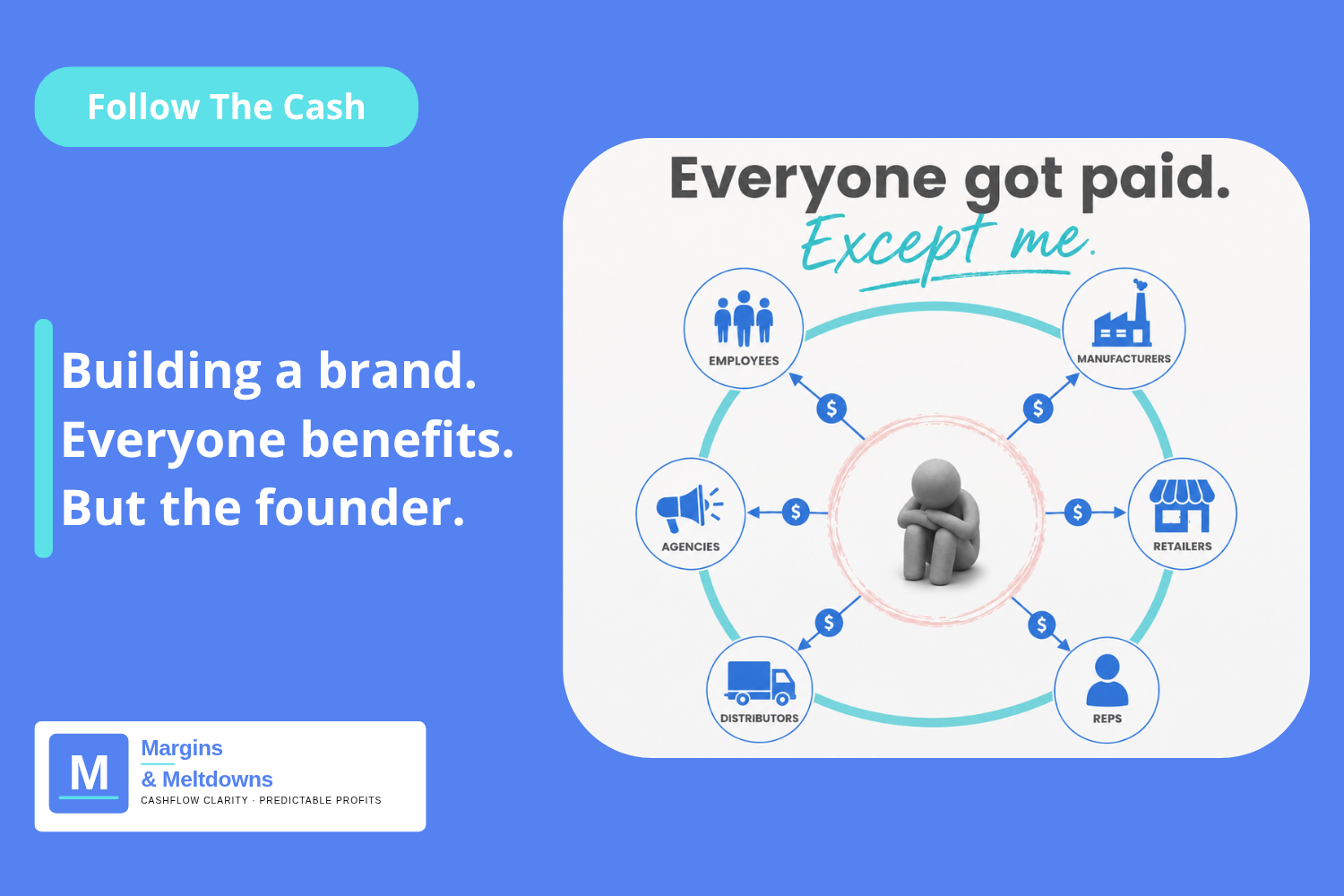
Meanwhile, look at who was getting paid. My employees. My manufacturing partners. The retailers taking their margin. The sales reps taking their commission. The distributors taking their cut. The marketing agencies on their retainers.
Everyone was making money off the brand I had created. Except me.
If that sentence stings, it's because you're living some version of it. Nearly every founder I now work with is. Growth that looks like success from the outside and feels like a treadmill from the inside. All funded by the one person who never invoices.
The single bank account problem
Through those years I ran the business the way most product founders do: one bank account, and a decision-making process that went look at the balance, decide whether we can afford it.
I call this bank balance decision making, and in good times it almost works. Revenue comes in, you eyeball the number, you place the purchase order, you pay the invoice. The balance is your dashboard, your forecast, and your permission slip, all at once.
Here's the problem. That balance is lying to you.
It looks like your money. It isn't. Some of it belongs to the tax department … it just hasn't left yet. Some of it is already spoken for by the production run you committed to last month. Some of it is the only profit your business will see this quarter, sitting there undefended, waiting to be spent on something urgent.
The money in that account isn't a cushion. It's six different obligations wearing a trench coat.
And when every spending decision is made against a number that lies, of course the owner gets paid last. There's never a moment when the balance looks like it can spare you a salary. There's always something more urgent wearing the disguise.
Every dollar gets a job
A few years into the rebuild — growing fast, still not paying myself — I found Profit First, Mike Michalowicz's methodology. The premise is almost insultingly simple, which is probably why it works.
The moment revenue arrives, it gets divided. Separate bank accounts: profit, tax, owner's pay, operating expenses, inventory. Set percentages. Moved on a schedule. No exceptions, no negotiating with yourself, no "just this once."
I didn't ease into it. I implemented it properly, and the effect was immediate and slightly disorienting. Like putting on glasses you didn't know you needed, seeing the money flow that way was visceral.
The operating account stopped lying, because it only ever held money that was genuinely available to spend. The tax account meant the bill that sinks so many product businesses was funded before it was due. The inventory account turned the terrifying question — can we afford this production run? — into a number I could simply read.
And the owner's pay account did something no amount of grit had managed in years: it made me one of the people who makes money from my own brand.
The test
A system adopted in calm conditions is interesting. A system that holds through a genuine crisis is something else.
When the pandemic hit, I was stranded in New Zealand running a US-based business, and I qualified for government support in precisely neither country. A different disaster from 2008, but the same fundamental question: can this business survive on nothing but its own cash flow?
This time, I didn't have to improvise. The allocations had been running for years. The tax money existed, in its own account, untouched. Inventory decisions were made from numbers, not from dread. The discipline that had been quietly compounding in the background did exactly what it had been training for.
I still carry no line of credit. Not because I'm against borrowing on principle, but because the system means I haven't needed one.
Why I call it survival training
You cannot install financial discipline in the middle of a crisis. Nobody learns to swim during the shipwreck. The founders who get through a downturn intact are not the ones who respond brilliantly when it hits. They're the ones whose boring, repetitive habits were already compounding before it arrived.
That's what cash flow discipline actually is. Not bookkeeping. Not tidiness. Training. Every small, scheduled allocation is a rep. Every funded tax bill or production run invoice is proof the muscle exists. And like all training, it works precisely because you do it when nothing is wrong.
The good news is that the entry point is almost embarrassingly small. You don't need to restructure your business. You need a second bank account and a starting percentage — even one percent — moved on a schedule, without exception. The percentage can grow. The habit is the asset.
Next week, in the final article of this series, I'll give you the playbook: what a bootstrapped product founder should actually be doing with their cash flow right now, given everything in front of us.
Survival is a skill. Skills are trained. Start training.
This is Article 3 of the Meltdown-Proof series.



Member discussion