The Playbook: What to Actually Do With Your Cash Right Now
Three articles in, and I've made my case. Product founders are sitting on an advantage nobody's pricing in. I've lived through two of my own economic apocalypses and come out the other side. And the thing that got me through wasn't grit — it was a system.
Here's where I stop telling you about the system and start handing it to you.
Not the whole methodology. Not a course. Just the handful of things you can actually go and do this week that will change how much you know about your own business.
The three things, and why most founders only ever look at one
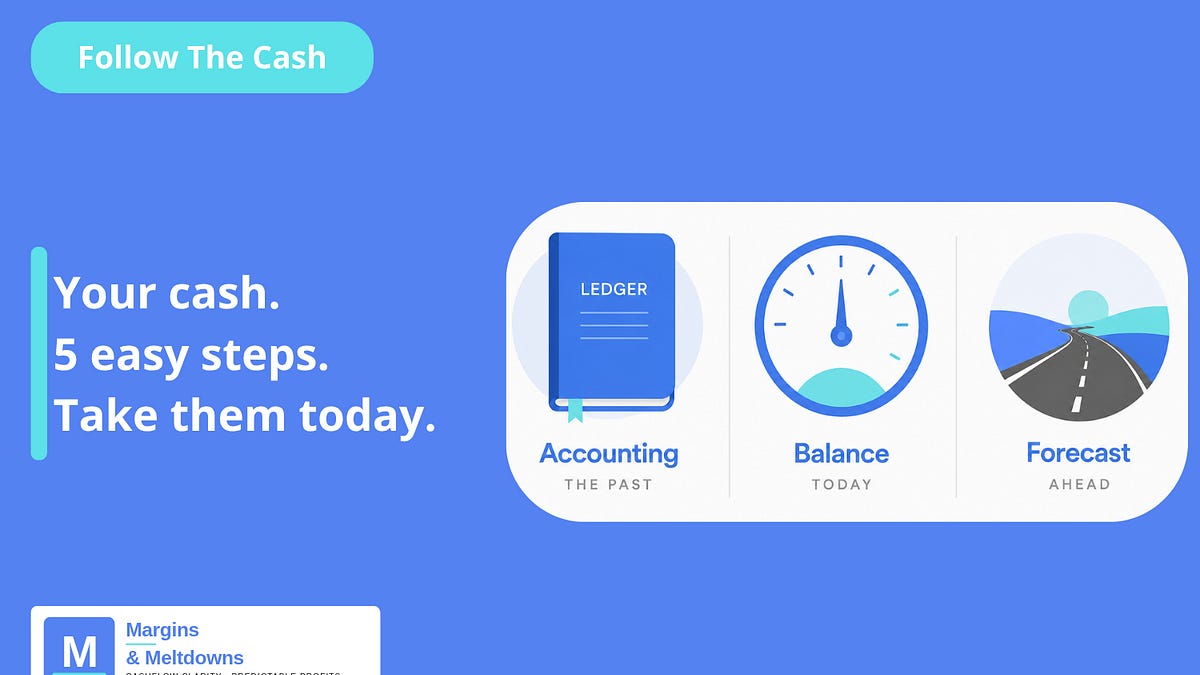
Your accounting tells you where you've been. Last month's numbers, closed and filed, true but already history.
Your bank balance tells you where you stand today. It's the number everyone checks first thing … sometimes before coffee. It feels like the truth because it's right there, real-time, undeniable.
Your forecast is the only one of the three that tells you what you can actually decide. Not what happened, not what you have, but truly what you can afford to do next, and when.
Most founders I work with run their whole business on the middle one. The balance. It's not wrong, exactly. It's just incomplete. It's a single frame from a much longer film, mistaken for the whole story.
1. Know your runway, not just your balance
Take your current cash on hand. Divide it by what you spend each month on average. That's how many months you have before the money runs out if nothing changes.
It takes ten minutes and most founders have never done it. Not because they're bad at business but because nobody ever told them this number existed, and the daily balance check feels like enough. It isn't. A balance tells you what you have. Runway tells you how long it lasts.
2. Separate the money before you touch it
You don't need a perfect multi-account system on day one. You need to stop treating every dollar that lands in your account as spendable.
Even a rough split — tax money moved out the moment revenue comes in, an amount to start saving for the next production run, a buffer set aside before anything else gets paid — beats one pooled account where you're making decisions by vibes. The point isn't the elegance of the system. It's that the money is already separated before you're tempted to spend it.
3. Price for cash, not just for margin
A healthy margin on paper doesn't help you if the cash isn't in the account when the supplier invoice or the purchase order comes due. Inventory businesses live and die by timing, not just percentages.
Before your next pricing decision, ask the question that actually matters: not just "is this profitable?" but "will the cash be there when I need it to be?"
4. Build the buffer before you need it
I learned this one the hard way — not because I didn't have a buffer, but because I did. When I got stranded on the other side of the world from my own supply chain, the buffer I'd already built from years of running Profit First was the only reason it was a disruption and not a disaster. A freight delay, a tariff change, a bad month — none of these are hypothetical for a product business. They're a matter of when, not if.
A buffer isn't a luxury you build once you're comfortable. It's the thing that determines whether the next disruption is an inconvenience or an emergency.
5. Look at the number you don't want to look at
Every founder has one — the account, the report, the figure they quietly avoid because they're afraid of what it'll say. The discipline isn't in never feeling that fear. It's in checking anyway, on a schedule, so it never gets the chance to turn into a crisis you find out about too late.
None of this is complicated. That's deliberate. The system that got me through two economic collapses wasn't clever — it was boring, repeatable, and followed even when I didn't feel like it.
Survival is a skill. Now you've got the training.
This is Article 4 of Meltdown-Proof: How Survival Became a Skill.


Member discussion