Three Levers to Pay Yourself More From Your Product Business
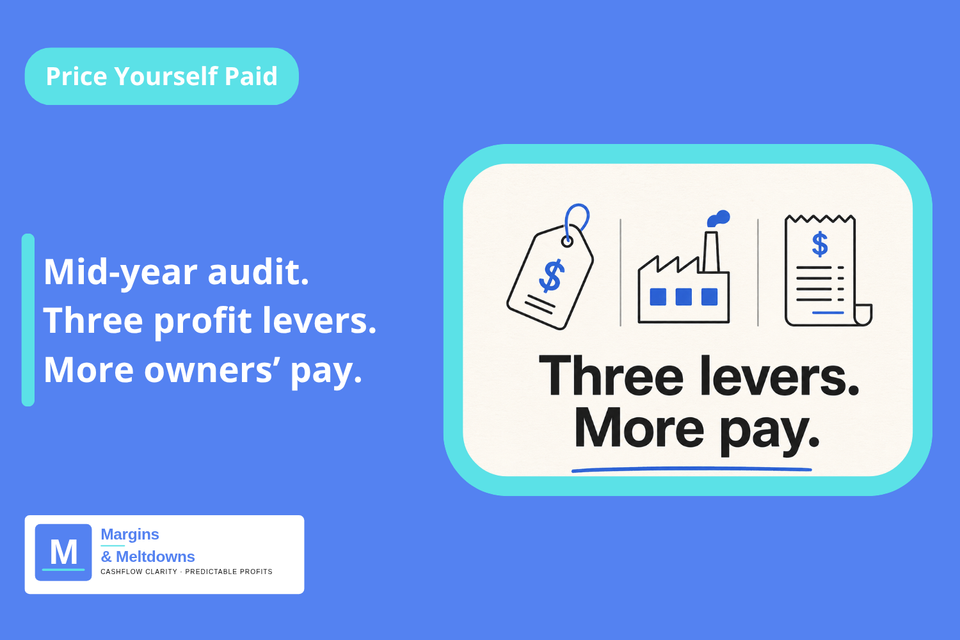
We’re halfway through the year — and if you’re a physical product founder who wants to pay yourself more, this mid-year point is the moment to look at three levers most founders never pull at the same time.
For a lot of founders, that landing somewhere between “already?” and a low-grade sense of unease. The first half of the year is behind you. Whatever you hoped would happen by now … either did, or didn’t.
This is the moment I pause. With myself, and with every client I work with. Not to beat anything up. But to ask a practical question: are the numbers actually working for you?
Not just for the business. For you.
Because here’s the thing I see over and over again: the business is turning over. Product is moving. Yet, the bank account isn’t exactly on fire … in either direction … good or bad.
And the founder still isn’t paying his or herself properly.
This isn’t a cash flow crisis. It’s a margin problem. Specifically, it’s a margin problem in three places most founders don’t look at, at the same time.
I run this process at the end of every quarter. At minimum, every six months. The mid-year point is the perfect moment to do it, because you have enough data to see patterns, and enough runway left in the year to actually do something about them.
Here are the three levers.
What are the three levers that grow your margin without extra sales?
Lever 1: Your pricing
I know. You’ve already thought about your pricing. You probably agonised over it before launch, checked it against competitors, maybe adjusted it once.
But when did you last look at it with fresh eyes?
Pricing isn’t a set-and-forget decision. It’s a live variable. And for most bootstrapped product founders, the price that felt right two years ago is now quietly underfunding the business because everything around it has gotten more expensive.
The question isn’t “can I charge more?” The question is: what would a modest price increase actually do to my margin?
Run the maths. Take your current unit economics and model what happens if you moved the price up by 5%. Then 10%. For most physical products, a 5–10% increase has a disproportionate impact on net margin because your fixed costs don’t change. You’re adding almost pure upside.
Will you lose customers? Some, possibly. But in my experience, the volume loss from a small, well-positioned price increase is almost always less than founders fear. And the margin recovery more than compensates.
If you haven’t revisited your pricing since launch, this half-year review is the place to start.
Margins & Meltdowns
Every Tuesday: the cash mechanics that matter for physical product founders. Pricing, margins, inventory, cash flow — from someone who has run a product business for 18 years.
Subscribe — it's freeLever 2: Your cost of goods
The other side of the margin equation is what you’re spending to make your product.
This one’s less glamorous than pricing, but it compounds in the same direction. A 3% reduction in your COGS has exactly the same effect on margin as a 3% price increase … except you don’t have to have a single conversation with a customer to get it.
Where to look:
Manufacturing. Have you had a frank conversation with your co-manufacturer recently about your unit costs? Or your ingredients suppliers. If your volumes have grown, you may have more leverage than you did when you first negotiated your rates. Even if volumes haven’t grown, it’s worth asking. Relationships and market conditions change.
Labour. If you are manufacturing in-house, have you managed to eke out any productivity gains, or have the labour costs increased in lock step with your volume increases? For you, the founder, if you are simply adding labour to keep up with volumes, you are simply building a larger machine that eats your cash and little flows down to you.
Freight. For inventory businesses, freight is often the cost that quietly balloons while everyone’s watching COGS. If you’re importing, are you reviewing your shipping arrangements regularly? Air versus sea, carrier comparisons, consolidation options. These aren’t one-time decisions.
Packaging. Material costs shift. Supplier relationships shift. If you locked in a packaging spec years ago and haven’t revisited it, there may be room to tighten without compromising what the customer sees.
You don’t need to overhaul everything at once. Pick the single biggest cost line in your COGS and ask: when did I last actually negotiate this?
Lever 3: Your operating expenses
This is the one that most founders leave on the table. Why? Because the individual numbers feel too small to bother with.
They’re not.
I’ll use my own business as the example. A few weeks ago I did my mid-year Opex audit and found I was paying for a Twitter add-on in my Metricool account. Twitter is not part of my content strategy. I have no idea when I added it or why I kept it. It was costing me $60 a year. Certainly not life-changing, but completely unnecessary.
I cancelled it immediately. And then I kept going.
Because that’s how these things work. The individual subscriptions are small. The cumulative picture is not.
Here’s a list of the categories worth checking:
- Marketing tools (scheduling, analytics, design platforms)
- AI tools (how many are you paying for that overlap?)
- Shopify apps (these are notorious for accumulating)
- Amazon software (seller tools, keyword trackers, listing services)
- Email platforms and automation tools
- Domain renewals (how many domains are you sitting on?)
- Storage and file management
- Course or community platform features you’re not using
- Software trials that rolled into paid subscriptions
Go through every line. Not just the ones you remember. Pull your bank and credit card statements and look at what’s actually coming out monthly and annually.
Now imagine you found, across all those categories:
- $60 on a social media add-on you don’t use
- $120 on a design tool upgrade that duplicates what you already have
- $180 on a software trial that quietly renewed
- $240 on a course platform feature no one’s accessed in six months
- $300 on an AI tool you tested once and moved on from
That’s $900 a year. Found, not earned. Without selling a single additional unit or landing a single new client.
For a product business operating on tight margins, $900 is meaningful. It’s a partial freight invoice. It’s a month of packaging materials. It’s the beginning of an owner’s draw that wasn’t there before.
Why this needs to be a recurring practice
The reason I do this quarterly, and with clients at least twice a year, is that cost creep is a slow leak. It doesn’t announce itself. Subscriptions renew quietly. Price increases come with a notification you click past. Manufacturing costs tick up with the market.
None of it feels urgent. All of it matters.
The mid-year point is a natural forcing function. You have six months of data, and you still have six months left to course-correct. That’s a genuinely useful position to be in.
So before the second half of the year picks up pace: pull the three levers.
Check your pricing. Review your COGS. Audit your Opex.
Not to find something dramatic. Just to find the quiet places where your margin is leaking. Then immediately plug them.
That’s how you get to the end of the year and actually pay yourself.
Want to work through this process with your own numbers? I work with physical product founders on exactly this — finding the margin that’s already in the business, and making sure it ends up in the right place. My methodology →
Margins & Meltdowns
Every Tuesday: the cash mechanics that matter for physical product founders. Pricing, margins, inventory, cash flow — from someone who has run a product business for 18 years.
Subscribe — it's freeJennifer McKinley is a cash flow strategist and the founder of Margins & Meltdowns. She holds a Yale MBA and has run COR Silver, a bootstrapped nano-silver skincare brand, for 18 years — navigating tariffs, air freight from South Korea, Amazon FBA, and every cash crunch an inventory business can produce. She works with physical product founders in New Zealand and the United States on cash flow clarity and Profit First implementation.



Member discussion