The Financial Cadence That Keeps My Business (and Sanity) Flowing
If money is energy, then managing it well is choreography.
Not spreadsheets and panic. Not receipts in a shoebox. Not the "I'll deal with it at tax time" sprint that ends in a large glass of wine and an existential crisis with QuickBooks at 2am.
When I first started my CPG company, I was so busy operating in the business I didn't have time to work on it — including my financial management. This manifested in avoidance and emergency. I'd ignore the numbers until something felt wrong, then panic-check everything in a caffeine-fuelled frenzy that solved nothing and stressed everything.
Then I discovered something that changed my entire relationship with money: rhythm.
Not more apps. Not a better accountant. Not "just try harder."
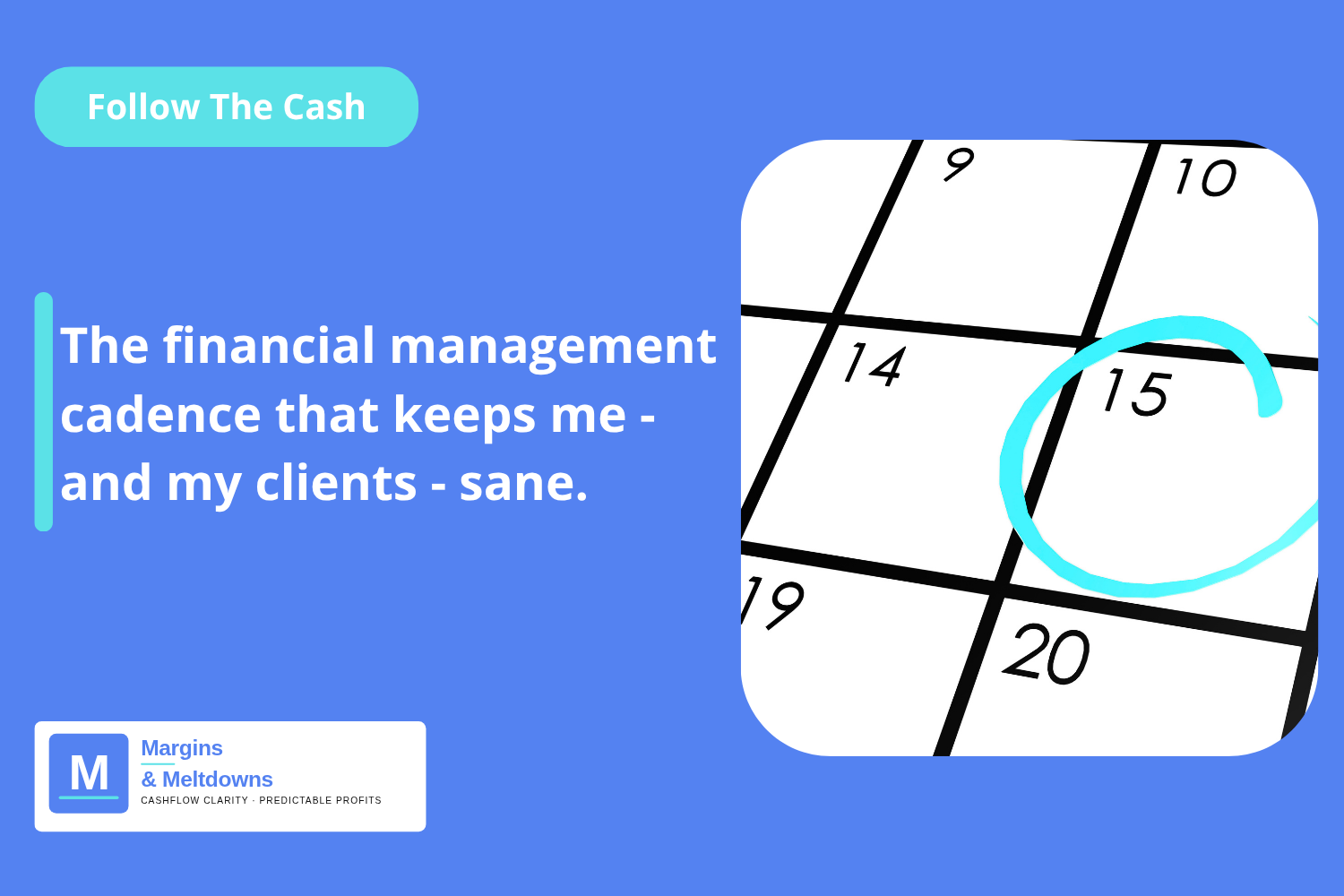
Just a simple, repeatable Financial Management Cadence. It allows me to stay clear on goals and execution against those goals. It keeps me connected to what really matters: sustainable freedom, not frantic hustle.
Here's the exact system I use to manage two businesses in under two hours a week.
Annually: The big picture
When: Once per year. I do mine in January when I'm home in New Zealand for the holidays.
Time investment: 6–10 hours.
This is where strategy meets soul — the dreaming, planning, and resetting. I close the books for taxes (now a breeze because I've saved for the tax bill all year in my Profit Hold account), run comprehensive profitability reports to see what actually worked versus what just felt busy, refresh visual dashboards, update my 10-year cash flow forecaster, and map the year ahead.
Without the annual view, you're driving with the windshield covered. You can see where you've just been, but not where you're going.
Quarterly: Strategy meets reality
When: End of March, June, September, December.
Time investment: 2–3 hours.
Every three months I put on my CFO hat and check the business heartbeat. I close the quarter's books, run profitability reports by product down to the SKU level, by distribution channel and by geography, reassess allocation percentages, compare forecasts to actuals, set actionable goals for the upcoming quarter, and take a quarterly profit distribution — because paying yourself isn't a perk, it's part of the process.
Three months is long enough to see patterns, short enough to course-correct without drama.
Monthly: The money dates
When: First week of each month, when all financial statements for the prior month are available.
Time investment: 60–90 minutes.
Monthly is where rhythm turns into ritual. I close the previous month's books, run profitability reports, compare results to the annual forecast, and practise the 4 R's: Revisit, Reap, Reassess, Reward. That last bit is non-negotiable — it's where I pause to reflect on what worked, celebrate wins, and adjust what's not working.
Monthly check-ins are like going to the gym. Skip one and it's fine. Skip three and suddenly you're starting from scratch again.
Weekly: The pulse check
When: Every Friday morning, or every other Friday depending on business complexity.
Time investment: 15–30 minutes.
This is the shortest, most frequent touchpoint — financial yoga that keeps you limber. I close out invoicing and expenses from the previous week, do bank allocations, update the 13-week cash flow forecaster, and set fresh financial and activity targets for the week ahead.
Small, consistent actions prevent big financial fires. Weekly check-ins mean you spot problems when they're fixable, not when they're existential. Weekly allocations also give you a small dopamine hit when you see the financial results of the activities you and your team have been working on all week. It's a form of positive reinforcement.
Why it works
Because rhythm creates freedom.
When money stops being an emergency, it becomes a conversation — between your present self and your future one. My Financial Management Cadence isn't about control; it's about trust. Trust that I have clarity around my numbers at any moment. Trust that my business is growing sustainably. Trust that calm, consistent stewardship beats chaos every single time.
Before I had this rhythm, I spent mental energy avoiding my finances. Now I spend that same energy building something sustainable.
The numbers don't scare me anymore. They inform me. And that shift — from fear to information — changes everything. All in less than two hours a week.
Want to build your own cadence?
If your finances currently feel like a mystery novel written during a panic attack, working one-on-one with me helps you create the same calm, repeatable rhythm I — and all of my clients — use. Simple, intuitive, and built for founders who want clarity without spreadsheets that make them cry.

Member discussion